 Baikal Shore
summer
The Circum-Baikal railway
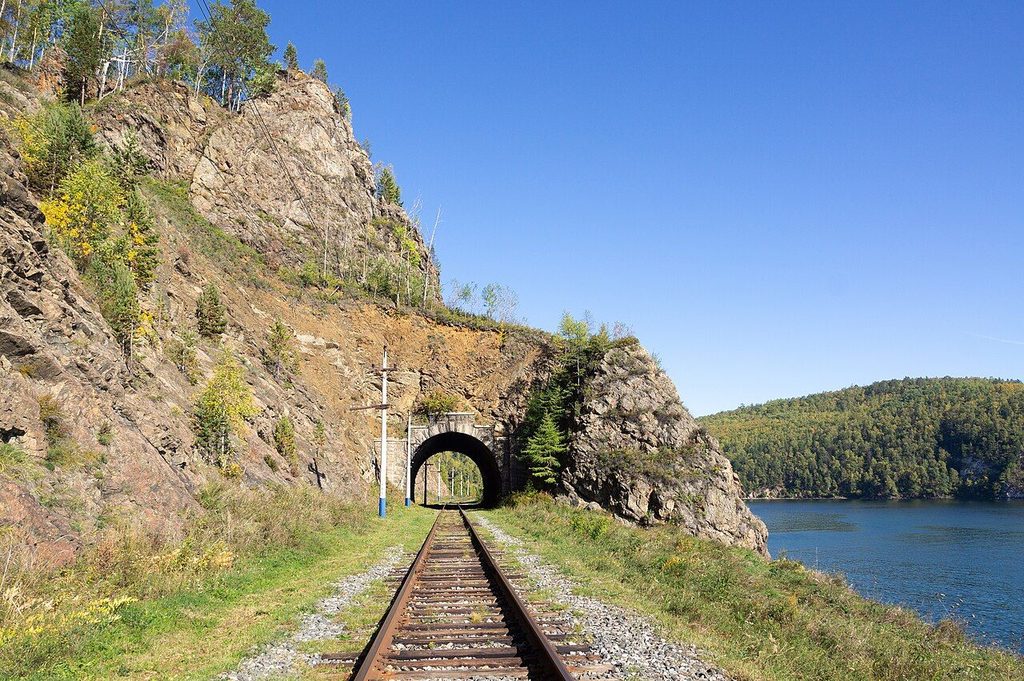
An old railway clings to the cliffs at the southern tip of Lake Baikal, with stone tunnels, galleries and bridges built over a century ago. Today it is a slow line, and a long walk.
 CC BY 4.0, Vyacheslav Argenberg
Trains still use the line. Keep off the track inside tunnels when one is due, listen carefully, and step well clear of the rails whenever a train approaches.
At the southern tip of Lake Baikal, between the old harbour of Port Baikal and the town of Slyudyanka, a railway runs along the foot of the cliffs. It follows the curve of the shore through tunnels cut into rock, across stone bridges over stream mouths, and under concrete galleries that protect the track from falling stones. For a short time it was part of the main route across Russia. Now it is a quiet branch, and one of the best ways to see this stretch of the shore.
Why the line was built
When the Trans-Siberian railway was laid across Russia at the end of the nineteenth century, Lake Baikal stood in the way. The shore at the southern end is steep, with mountains running straight down to the water. Building a line along it would take years. For a time, trains were carried across the lake by ferry from Port Baikal to the eastern shore, using large ice-breaking ships.
In winter, when the ferries struggled, there were other improvisations, including rails laid across the frozen lake. Meanwhile, work went ahead on the shore line. Engineers cut dozens of tunnels and built many galleries, retaining walls and bridges, much of it in dressed stone. The line opened in the first years of the twentieth century, and through trains ran along the lake for some decades.
When a dam was built on the Angara at Irkutsk in the 1950s, the section of track between Irkutsk and Port Baikal along the river was flooded. A new main line was built over the hills to the south, reaching the lake at Slyudyanka. The stretch along the cliffs from Slyudyanka to Port Baikal was left as a branch with no outlet, and it has stayed that way.
Tunnels, galleries and bridges
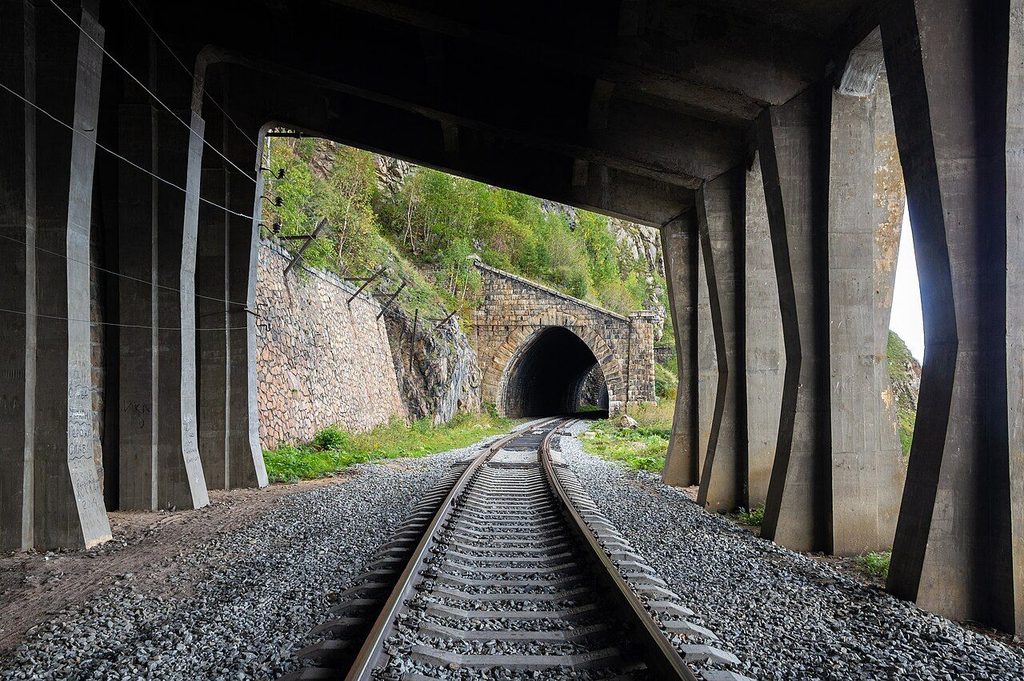
The line is famous for its engineering, and walking it you see why. The tunnels are numbered, and their portals are framed in stone, some with carved details and dates. Some are short enough that you see daylight at the far end; others curve into darkness and you need a torch.
 CC BY 4.0, Vyacheslav Argenberg
Galleries are open-sided structures that let the track pass below a slope while shielding it from rockfall, and you find several along the line, including the paired old and new galleries near Cape Khabartuy. Stone bridges and culverts carry the track over streams coming down from the hills, and long retaining walls hold the embankment in place against the lake. All of this sits in a narrow strip between rock and water.
The line has been recognised as an important engineering monument, and parts of it have been restored. Treat the structures with care: do not climb on walls or portals, and do not take stones.
The slow train
A local train has run along the branch, slowly, stopping at small halts and settlements. It is used by people who live along the shore and by walkers who want to be dropped at a point on the line and picked up later. Tourist trains have also run along the route in summer, with longer stops at viewpoints and points of interest.
Further along the shore: Planning a Baikal trip, carefully
Both kinds of service are infrequent, and the days and times change from season to season. Phone coverage along the line can be patchy.
At the northern end, Port Baikal faces Listvyanka across the mouth of the Angara, and a small ferry has crossed between the two in the warmer months. Our note on Listvyanka, where the Angara leaves the lake describes the village on the other side.
Walking the line
Many people walk sections of the railway. The track gives a level path along a coast that would otherwise be very hard going, and between tunnels you have the lake on one side and cliffs on the other. Small coves and pebble beaches open up along the way.
Some practical points matter here:
- Trains still use the line. Walk beside the rails rather than between them where you can, and listen for engines, especially near tunnels and on curves.
- Inside a tunnel, the sound of an approaching train can arrive late. Keep tunnel walks short, use a torch, and know where the nearest refuge is.
- Sleepers and ballast are tiring to walk on. Distances that look short on a map take longer than you expect.
- Ticks are active in late spring and early summer in the grass beside the line. Check yourself at the end of the day.
- There are few shops along the way. Carry water and food.
Some walkers combine the railway with the shore paths further north; our note on walking the shore describes the coastal trail near Listvyanka.
Port Baikal and the southern end
Port Baikal was once a busy ferry harbour. Today it is a small settlement with old railway buildings, the remains of the piers and a quiet shoreline. The view across the Angara to Listvyanka is good, and the station area still shows its past.
At the southern end, Slyudyanka sits on the main Trans-Siberian line, and it is the usual place to begin a walk or train journey along the branch from that side. The town has a station, shops and a long shoreline, and it is a calm place to start a day on the line.
Seasons on the line
Summer and early autumn are the obvious times to go. The days are long, the trees on the slopes are green or turning gold, and the beaches are open. Autumn can be especially fine, with clear air and colour on the hills. Winter is quiet and very cold, the lake freezes alongside the line, and walking is harder and slower; the ice beside the track should never be treated as a path. For more on the lake in that season, see our note on Baikal's winter ice.
Whatever the season, the railway is a slow pleasure. You see the lake from the edge, at walking pace, along a line that took enormous effort to build and now carries very little.
- Getting there
- Train from Slyudyanka or ferry to Port Baikal
- Bring
- Headtorch, sturdy shoes, water, insect repellent, layers